A coefficient is a constant coefficient when it is a constant function. For avoiding confusion, in this context a coefficient that is not attached to unknown functions or their derivatives is generally called a constant term rather than a constant coefficient.
In mathematics, a coefficient is a number or any symbol representing a constant value that is multiplied by the variable of a single term or the terms of a polynomial. It is usually a number, but sometimes may be replaced by a letter in an expression.
The meaning of COEFFICIENT is any of the factors of a product considered in relation to a specific factor; especially : a constant factor of a term as distinguished from a variable.
A coefficient is a scalar value that indicates the variable's impact on an expression. When a variable in an expression has no written coefficient, it is assumed to be one, because multiplying by 1 does not change its value.
Illustrated definition of Coefficient: A number used to multiply a variable. Example: 6z means 6 times z, and z is a variable, so 6 is a coefficient....
Coefficients are commonly represented using a, b, and c: The equation above is the standard form of a quadratic equation in which x is the only variable, a and b are coefficients of the variable x, and c can be referred to as the constant coefficient.
Learn what a coefficient is in math with simple examples, definitions, and FAQs for students. Understand the meaning of coefficients and see how they work.
A coefficient is a number that multiplies a variable in a mathematical expression or equation. It tells you how many times the variable is being used or scaled.
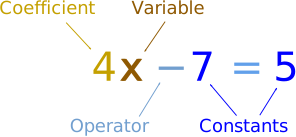 Illustrated definition of Coefficient: A number used to multiply a variable. Example: 6z means 6 times z, and z is a variable, so 6 is a coefficient....